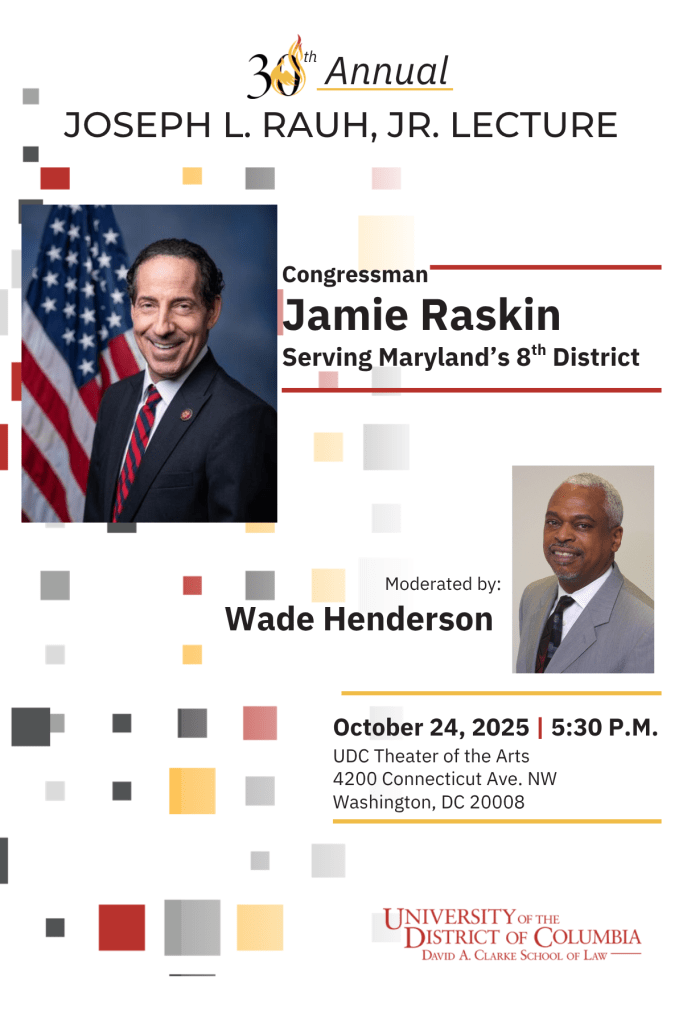
Join us for this year’s Joseph L. Rauh, Jr. Lecture delivered by Congressman Jamie Raskin, Serving Maryland’s 8th District. Moderated by Wade Henderson.
Join us for this year’s Joseph L. Rauh, Jr. Lecture delivered by Maya Wiley, President and CEO of The Leadership Conference on Civil and Human Rights.
Tuesday, April 4, 2023 at 6 p.m. UDC Law Moot Court Room 4340 Connecticut Avenue NW Washington DC 20008
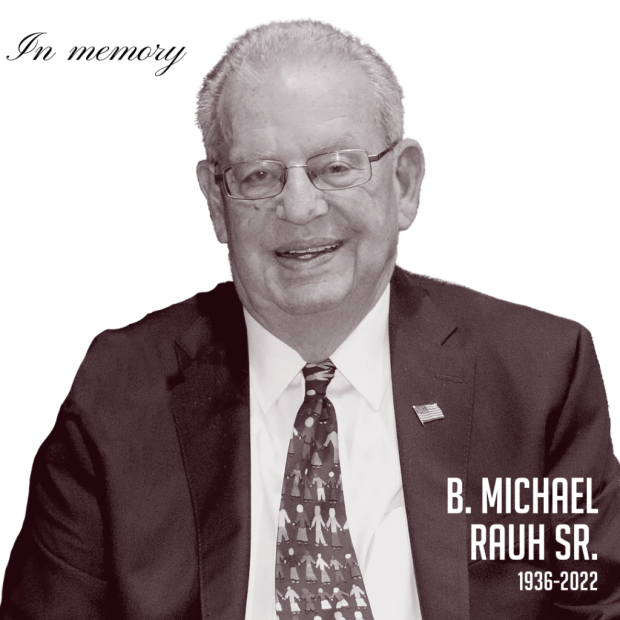
Celebrating 30 years since the first Joseph L. Rauh, Jr. Lecture at UDC Law and remembering Michael Rauh, Chair Emeritus of the DC School of Law Foundation. Wade Henderson, Joseph L. Rauh, Jr. Professor of Public Interest Law Emeritus, will introduce Maya Wiley. Catered reception to follow.
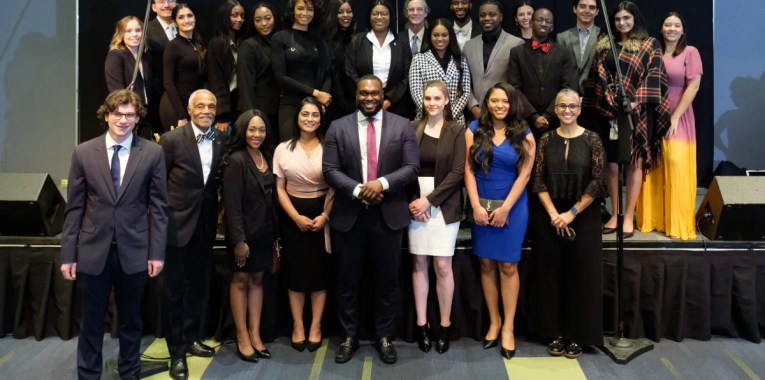
The University of the District of Columbia David A. Clarke School of Law (UDC Law) held its fifth annual UDC Law Gala on Nov. 17 at the University of the District of Columbia Student Center. The event, designed to support student scholarships and fellowships, also marked the culmination of a year-long celebration of UDC Law’s fiftieth anniversary.
More than 150 people gathered for the night’s events, centered on honoring the history and legacy of the law school. Regina Shaw ’97 and Freddie Mac received the 2022 Charles J. Ogletree, Jr. Champions for Justice Awards, and Karen Newton Cole ’87, Rochanda Hiligh-Thomas ’96, Saleema Snow ’97 and LaRuby May ’06 were inducted into the inaugural class of the UDC Law Alumni Hall of Fame.
The program featured remarks from Acting Dean Twinette Johnson, DC School of Law Foundation (DCSLF) Chair Jon Bouker, and 4LE Nija Bastfield. Donald Calloway (MSNBC, Pine Street Strategies) hosted the evening, and guests enjoyed musical performances from Yolanda F. Johnson, the UDC Chorale and Shawn Allen’s Choice Band.
Dean Johnson spoke to the history and future of the law school, acknowledging the impact of losing Dr. Edgar S. Cahn in January. Cahn was the co-founder – with his wife Jean Camper Cahn – of UDC Law’s predecessor school in 1972. Johnson noted members of the Cahn family were in attendance and then spoke to the strength of the Cahns’ impact, “For the first time in fifty years, we will have a class who have not had the opportunity to be imparted with his wisdom firsthand. Edgar and Jean taught us all, so it is the responsibility of all of us to share what we’ve learned.”
She then discussed the future of UDC Law. “This year, after enduring the pandemic, we have reopened our doors to 100% in person learning. We celebrated our 67 graduates as they entered the legal profession and welcomed one of our largest incoming classes to date,” she said, adding, “As one of only six Historically Black law schools in the country, we are essential participants in the effort to make this a more just and equitable society.”
Bouker also recognized the Cahn legacy and followed with recognition of the passing of B. Michael Rauh, whom Bouker described a staunch supporter of UDC Law. Rauh was a long-time member of the DCSLF Foundation Board. Bouker ended by saying, “We honor Mike and Edgar’s memory by remaining steadfastly committed to the mission of this great institution.”
In a surprise presentation, Bastfield presented University of the District of Columbia President Ronald Mason, Jr., with a suit jacket from SuitShop. In August, SuitShop provided each member of the incoming class a suit jacket to kickstart their legal career.
Dean Johnson returned to the spotlight after dinner to induct the inaugural class into the UDC Law Alumni Hall of Fame. To celebrate 50 Years, UDC Law established a Hall of Fame to honor alumni (living or deceased) whose exemplary careers, extraordinary service or outstanding contributions to UDC Law have significantly impacted our community and beyond. Inductees were nominated by members of the UDC Law community, and a selection committee carefully reviewed and chose Newton Cole, Hiligh-Thomas, Snow and May as the first four members of this new tradition. A virtual Hall of Fame has been established and will live permanently on the UDC Law website.
A reverse auction followed the Hall of Fame induction, adding to the over $108,000 raised for the night.
For the third year, the Charles J. Ogletree, Jr. Champions of Justice Awards were presented at the Gala. Barry Parsons accepted the award on behalf of Freddie Mac; Parsons is Associate General Counsel at Freddie Mac. Shaw was chosen for the award for her commitment to the public interest.
The Charles J. Ogletree, Jr. Champions of Justice Awards are presented to individuals who are using their position and platform to promote social justice and equality throughout the United States and abroad. “Named after one of the most prolific and influential social justice advocates of our time,” Calloway said as he invited the awardees to accept their awards, “the recipients of this award exemplify the same values embodied by Professor Ogletree and UDC Law’s commitment to public service.”
The UDC Law Gala celebrates leaders advancing the fight for justice and helps to provide students with an award-winning, social justice-focused legal education without the burden of unmanageable student debt.
UDC Law is committed to educating groups that are traditionally underrepresented at the Bar. Heralded as one of the best and most affordable schools for Black students, UDC Law is home to the largest female and one of the most diverse (law) student populations in the nation.
UDC Law’s clinical programs have provided life-saving legal services to the most vulnerable members of the broader DC community for the last 50 years. In the face of unprecedented challenges, in academic year 2021-22, UDC Law students consistently rose to meet the demands of a rigorous curriculum, adapted to a different style of life and learning and completed over 35,000 hours of clinical work and more than 4,400 hours of service to the D.C. community. UDC Law is steadfastly committed to community and dedicated to practicing law, promoting justice and changing lives.
The District of Columbia School of Law Foundation cordially invites you to the fifth annual
UDC Law Gala Thursday, November 17, 2022, at 6:30 p.m. UDC Student Center Ballroom 4200 Connecticut Avenue NW, Washington, DC 20008
Get your tickets now and join us as we honor Regina H. Shaw, ’97, and Freddie Mac with the Charles J. Ogletree, Jr. Champions of Justice Award.
The UDC Law Gala is a culminating event that celebrates leaders advancing the fight for justice and helps us to provide UDC Law students with an award-winning, social justice-focused legal education without the burden of unmanageable student debt.
UDC Law is committed to educating groups that are traditionally underrepresented at the Bar. Heralded as one of the best and most affordable schools for Black students, UDC Law is home to the largest female and one of the most diverse law student populations in the nation.
On Tuesday, Nov. 9, the District of Columbia School of Law Foundation hosted the Fourth Annual UDC Law Gala at the University of the District of Columbia Student Center Ballroom, raising $135,425 toward supporting students through tuition scholarships, fellowships and bar study programs. The funds raised at the gala came from sponsorships, ticket sales and a reverse auction held during the event. Overall, the amount raised at the gala contributes to a 2021 total of $ 718,706. Guests tuned in virtually from around the country, including Georgia, California, New York and Florida.
The Gala traditionally honors individuals who use their position and platform to promote social justice and equality throughout the United States and abroad with the Charles J. Ogletree, Jr. Champion of Justice Award. The recipients of the award exemplify the same values embodied by Professor Ogletree and UDC Law’s commitment to public service.
Renee Montgomery, Co-Owner and Vice President of the WNBA’s Atlanta Dream, received this year’s Charles J. Ogletree, Jr. Champion of Justice Award. At the gala, Montgomery’s sister Nicole Young accepted the award on her behalf. Montgomery and the Atlanta Dream have consistently used their platform to fight for real justice and equity for all, including efforts to negotiate for fair pay, leadership in the Black Lives Matters Movement and Say Her Name Movement and supporting voters in Georgia’s recent senatorial elections. Montgomery is the first WNBA alumni to co-own a WNBA team.
An estimated 200 guests participated in the evening’s program, with 100 guests participating in person and all others participating virtually. Aimed at expanding the geographic reach of the event and creating a parallel experience for in-person and virtual attendees alike, the Foundation enlisted District Graze to deliver custom charcuterie boxes to the homes of virtual participants located in the D.C. Metro area moments before the opening remarks.
Highlights of the evening’s program – which was stewarded by emcee Don Calloway, former member of the Missouri House of Representatives and CEO of Pine Street Strategies – included the moving vocal performance by the UDC Chorale led by Professor Johnny Butler and the stirring medley of popular and original works by celebrated harpist Brandee Younger.
Anchoring the purpose of the event, UDC Law students Jamal Bailey, Pearl Mansu and Yaman Shalabi shared with the crowd the many ways funds raised through DCSLF efforts have helped them pursue their legal education. Shalabi, a third year evening student, credited the school for inspiring her to go into public service after graduation. “UDC Law’s power lies within its ability to push you far past the edge of your limits only to discover you are capable of more. It ignites in its students a passion to live with purpose and to live for others.”
Bailey and Mansu, both slated to graduate in 2022, have already accepted positions at Paul, Weiss, Rifkind, Wharton & Garrison LLP and Reid Smith LLP, respectively.
The DCSLF gives tens of thousands of dollars each year to support UDC Law students on their journey to becoming the country’s next generation of justice advocates. DCSLF Board Chair and Arent Fox Partner Jon Bouker emphasized the Foundation’s commitment to extend its reach to support more students in the future. “We cannot stop here. We will not stop here. We must ensure that our graduates are placed in positions where they can impact change. For the students, I want you to know that we believe in you and we are invested in your success because we know that the key to a future of a more just and equitable society is placed firmly within your capable hands.”
The District of Columbia School of Law Foundation cordially invites you to the fourth annual
UDC Law Gala Tuesday, November 9, 2021, at 6:30 p.m.
This will be a hybrid event taking place simultaneously in-person at the UDC Student Center Ballroom and virtually.
Get your tickets now and join us as we honor Renee Montgomery and the Women’s National Basketball Association’s (WNBA) Atlanta Dream withthe Charles J. Ogletree, Jr. Champions of Justice Award.
Renee Montgomery is the first WNBA alumni to co-own a WNBA team – the Atlanta Dream. Montgomery and the Atlanta Dream have consistently used their platform to fight for real justice and equity for all, including efforts to negotiate for fair pay, leadership in the Black Lives Matters Movement and Say Her Name Movement, and supporting voters in Georgia’s recent senatorial elections.
A leading voice of the harp today, performer, composer, educator and concert curator Brandee Younger defies genres and labels. Recently awarded Rising Star Harpist in Downbeat Magazine’s 2020 Critics Poll, she has performed and recorded with artists including Pharoah Sanders, Ravi Coltrane, Jack Dejohnette, Charlie Haden, Common, John Legend, The Roots, Stevie Wonder and Lauryn Hill. In 2020, she released her fifth album Force Majeure and her original composition “Hortense” was featured in the Netflix Concert-Documentary, Beyoncé: Homecoming.
The event supports UDC Law’s mission to train the next generation of public service leaders.
Don’t miss this opportunity to participate in this joyful event supporting the District’s only public law school, one of only six accredited law schools at a Historically Black College or University (HBCU). We look forward to celebrating with you virtually or in person!
Attorney General for the District of Columbia Karl A. Racine delivered the 2021 Joseph L. Rauh Jr. Lecture in March, in which he focused on the office’s efforts in affordable housing, worker rights, juvenile justice and combating hate. Following his remarks, Racine took questions from the virtual audience of more than 100 attendees.
Dean Renée Hutchins introduced the Attorney General, who began his talk with heartfelt praise for the University of the District of Columbia and reminded the audience that his mother, who died in late 2020, taught at UDC for fifty years. Marie-Marcelle Buteau Racine began her teaching career at Federal City College, a predecessor school to UDC, and spent those decades teaching foreign language and serving as dean and department chair.
Racine then emphasized the importance of UDC and particularly the David A. Clarke School of Law in addressing the issues he discussed. He described the job of the Office of the Attorney General for the District of Columbia and the positive impact UDC Law students have in helping the office conduct its work. Racine’s talk centered on the public interest work being done by the Office of the Attorney General both locally and nationally.
He first described how the office focuses on the rights of tenants and fights for affordable housing. Washington has experienced a surge in new residents, Racine said, “but also the most intense most intense displacement of District residents, overwhelmingly Black, brown and lower income people” as a result of policies that favor development. Thus, “standing up for tenants is one area of the public interest that the Office of the Attorney General has pursued.”
Next, Racine turned to worker rights as another priority of the office. “We are in a terrible pandemic of wage theft and worker misclassification in the District,” he said. Construction is ubiquitous in D.C., which Racine argued is a clear sign there is wage theft occurring. He stressed that such practices more often affect immigrants and poor “hardworking people who are vulnerable and often don’t complain.”
Locally, juvenile justice has also been a key initiative in the office with an emphasis on “prosecuting kids without bringing them into the criminal justice system.” Racine said efforts to increase diversion and restorative justice have been successful in reducing recidivism in youth.
Racine closed his speech with some of the national issues in which his office has been instrumental, including ensuring people who need access to programs like Supplemental Nutrition Assistance Program (SNAP) continue to receive those benefits and combating the increase in hate over the past several years. Racine said his office teamed up with 22 other attorney general offices to stop the previous administration from creating additional obstacles for people who receive benefits like SNAP. He moved next to the ways in which the office is working to eliminate the “outrageous,” “exponential” growth in hate. He said it’s important to call hate out and work to stop it with policies that recognize its complexity. “A lot of the hate we’re seeing has intersectionality to it,” he said, adding that much of it falls on women and using the Atlanta spa shooting in March as an example. “It’s so important we have a better tone at the top of the United States government,” Racine said, “we cannot foster, condone, encourage or defend hate groups.”
Racine thanked the virtual crowd before taking questions from the audience, which Dean Hutchins moderated. Topics included domestic terrorism and political rhetoric, the impact of systemic issues on the work of the office, the future of D.C. statehood, District responses to the Jan. 6 insurrection, the benefits of hiring from diverse law schools, ways in which D.C. residents and law schools can help with the programs at the Office of the Attorney General, plans for additional LGBTQ+ protections, a post-COVID safe return to work and progressive efforts in law enforcement. There was also a bit of speculation on Racine’s future with a question about whether he would run for office, to which Dean Hutchins counteroffered – somewhat tongue-in-cheek – that he would always be welcome to teach at UDC Law. The Attorney General answered masterfully, leaving all doors open but not tipping his hand.
On Thursday, Oct. 24, AFL-CIO President Richard L. Trumka delivered the 27th Annual Joseph L. Rauh, Jr. Lecture, linking the history and future of labor rights and reminding the audience of Rauh’s role in paving the way for union democracy. Trumka’s long-time mentor and friend Joseph “Chip” Yablonski introduced Trumka to the audience, describing the ties between Trumka, Rauh and Yablonski’s father, labor rights activist Joseph “Jock” Yablonski. UDC Law Dean Renée McDonald Hutchins provided opening and closing remarks.
Hutchins thanked the large crowd in the Moot Courtroom before providing a brief overview of the Rauh Lecture’s impact on the UDC Law community. In the audience were UDC Law faculty and students, University of the District of Columbia (UDC) Chief Academic Officer Lawrence Potter, deans and faculty from across UDC, members of the DC School of Law Foundation Board, the leadership of American Federation of State, County and Municipal Employees (AFSCME) and guests from the community. Hutchins acknowledged the guests before praising the students, calling them “my guiding star in terms of my leadership.” She then asked for a moment to recognize the passing of Rep. Elijah Cummings and a beloved member of the UDC Law community, Professor Wilhelmina Reuben-Cooke.
Remembering Joe Rauh
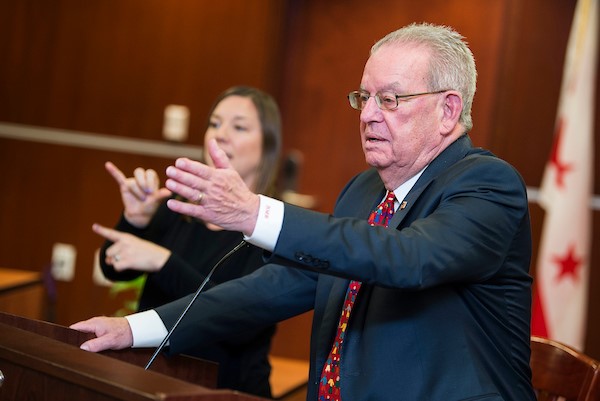
Joseph “Chip” Yablonski introduces Richard L. Trumka at the 27th Annual Rauh Lecture at UDC Law Oct. 24, 2019. (Photo: Cheriss May)
In his introduction, Yablonski tied Trumka to his father and to Rauh, calling the latter “the greatest mentor of young lawyers – at least young liberal lawyers – in Washington in my lifetime.” Rauh represented Yablonski’s father when he challenged W.A. “Tony” Boyle for the presidency of United Mine Workers (UMWA) in 1969. Despite losing the election, the elder Yablonski and Joe Rauh fought for union democracy until Jock, his wife and his daughter were murdered on New Year’s Eve in 1969. Yablonski praised Rauh’s impact on the investigation and acknowledged his role in helping the family weather the tragedy. Rauh was instrumental in urging the FBI and Department of Justice to investigate the murders, for which Boyle ultimately served time several years later. “That night [of the murders] is sort of indelible to me in terms of Joe’s humanity and his strategic vision,” Yablonski told the crowd.
Rauh was also influential in reforms that led UMWA to adopt, according to Yablonski, “the most democratic union constitution in the United States, probably the world.” It was around then, as well, that Yablonski and Trumka’s paths crossed. Yablonski hired Trumka – who had been studying in the mines by the light of his helmet lamp through Penn State and Villanova Law – to what he called “probably the most ambitious and bright group of lawyers ever assembled for a labor union.”
Making the ultimate sacrifice for union members
After working for UMWA for a time, Trumka chose to fight the union dysfunction he had observed, first returning to the mines to reach the required number of service years to run for international union office. “You can have all kinds of measures about what a union leader ought to be,” Yablonski remarked, “but somebody that gives up writing briefs and arguing motions in an air-conditioned environment to go to work underground is somebody that is making the ultimate sacrifice for his union members.”
Yablonski concluded his introduction with a summary of Trumka’s leadership before acknowledging that “Joe Rauh would be very, very pleased at our speaker tonight,” calling him “the heir of Joe Rauh’s legacy.”
Creating value out of a hole in the ground
Richard L. Trumka shares stories of working in the mines, studying to prepare for eventual union leadership at the 27th Annual Rauh Lecture at UDC Law Oct. 24, 2019. (Photo: Cheriss May)
Trumka’s message centered on the importance of unions for today’s worker, connecting the history of union democracy to current issues of labor and democracy. Forming the basis of his career philosophy, Trumka noted that, “if you want to help workers, you first need to know and help people.” Trumka got to know those people and workers by going into the mines, and he took the lessons he learned with him throughout his career. “The education I got in the mines far exceeds anything I got at Penn State or Villanova,” Trumka said. “It’s a job that teaches you the nature of hard work, creating value out of a hole in the ground.”
While Trumka was working and studying in Pennsylvania, the United States faced a number of key moments in its history, chief among them the fight for civil rights. As the public sector grew, Trumka explained, so did the demand for better working conditions. “People were striking to be recognized and have the dignity of a human being,” he explained, as he recounted the events of the 1969 Black Lung Strike in West Virginia and the Memphis Sanitation Strike where Martin Luther King Jr. was assassinated.
Returning to his own experience, Trumka detailed the dysfunction he observed in the unions. Even as the governor of West Virginia was signing the first piece of legislation to recognize black lung as an occupational hazard, mine workers were fighting for basic rights in the Boyle-led UMWA. Trumka described the difficulty workers faced in understanding their rights; it was not possible for workers to receive copies of union contracts or constitutions, for instance. “If you tried to file a grievance,” Trumka said, “they’d tell you that, ‘we’ll tell you when you have a grievance.’”
Your fight is my fight and my fight is your fight
Trumka then highlighted Rauh and Jock Yablonski’s attempts at battling labor union corruption in the late 1960s. Jock, Trumka noted, “was a symbol of everything we’d been fighting for – a union that has your back, true solidarity – where your fight is my fight and my fight is your fight. And thanks to this evening’s namesake, that all became clear again to us.”
After Jock’s death, Rauh continued to fight for union democracy and did so with more support from mineworkers, many of whom rallied behind the late Yablonski’s cause. About Rauh, Trumka added, “he was your guy. When Joe Rauh was your lawyer, he was your lawyer.” Trumka cited Yablonski and Rauh’s efforts as the catalyst for union momentum in the 1970s and its effect on his own career. Trumka became President of United Mine Workers in 1982, and he fondly recalled being sworn in by his father – “who had given his life to his union” and later died of black lung, “like every man in my family in that generation.”
Connecting those earlier efforts for union democracy to similar issues workers face today, Trumka said that, just as members nearly fifty years ago “stopped looking at their shoes,” today’s workers are also “looking our employers squarely in the eye and delivering a clear message: ‘Enough. Enough.’” He credited Jock Yablonski and Joseph Rauh for making that possible both then and now.
It is the “systems and institutions we’re supposed to rely on” that stand in the way of progress for workers today, he continued. Trumka argued those systems are rigged in favor of corporations and politicians and that democracy itself is in jeopardy. He cited a Harvard Law study that found only 30 percent of Millennials believe it is essential to live in a democracy and 25 percent even said democracy is a bad thing. Trumka contended this is a result of an economy and political system that does not work for them; “young people and workers in general are becoming more disillusioned as they bear the brunt of a broken economy.” Citing flat wages, subpar healthcare and disappearing pensions, Trumka said the threats to union democracy and democracy in general are “startling and heartbreaking” given the efforts of previous generations.
Times are tough, but so are working people
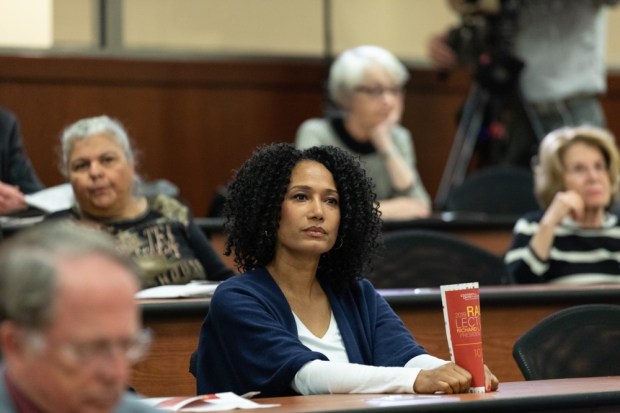
Audience members listen to 27th Annual Rauh Lecture with AFL-CIO President Richard L. Trumka at UDC Law Oct. 24, 2019. (Photo: Cheriss May)
Despite sounding a mild alarm, Trumka offered hope to the audience, saying he has “never been more optimistic” in light of current collective actions – striking teachers in Chicago and auto workers in Michigan, Black Lives Matter and #MeToo – “where people are saying, ‘the only way we’re going to get this done is if we stand together, if we lock arms with the people standing next to us.” He stressed the impact of “ordinary people” effecting “extraordinary” change.
Reminding us that the role of unions is to provide better conditions for working people, Trumka urged the audience to turn to one another and use the momentum of current social action to keep fighting for “a voice and democracy on the job.” He added, “times are tough, but so are working people. We never give up without a fight.”
He closed his talk with advice for the law students in the room. Soon, he told them, “they will send you off into a complicated world with an extraordinary opportunity and responsibility to make a difference.” Then he asked them to consider how they would meet that challenge, urging them to work to advance fairness and freedom, to fight inequality. “Fifty years after Jock died and Joe helped all of us move on,” Trumka said in closing, “you can help strengthen democracy for generations to come. You can. And I truly hope that you will be lawyers for democracy and make Joe Rauh proud of you because he fought every day for that – and for the little guy.”
Trumka then took questions from the audience that built on some of the topics he had discussed and highlighted additional labor concerns like the growing roles of artificial intelligence and automation, the impact of social media on labor organizing and the future of the North American Free Trade Agreement.
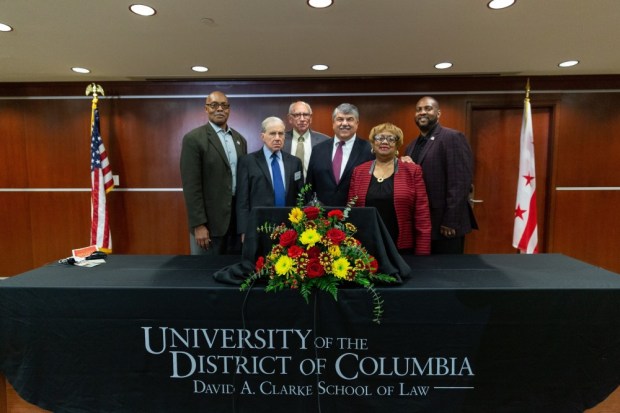
AFL-CIO President Richard L. Trumka, fourth from left, poses with Dan Edelman, second from left, and AFSCME Local leaders, from left, Robert Alston, President AFSCME Local 2921; Laverne Gooding-Jones, President AFSCME Local 2087; and Robert Hollingsworth, President AFSCME Local 2776 prior to the 27th Annual Rauh Lecture Oct. 24, 2019. (Photo: Cheriss May)
The University of the District of Columbia David A. Clarke School of Law invites you to its Third Annual Gala
An Evening to Benefit UDC Law’s Scholarship and Fellowship Programs
presenting the inaugural
Charles J. Ogletree, Jr. Champion of Justice Award
to
Sherrilyn Ifill
President and Director-Counsel of the
NAACP Legal Defense and Educational Fund, Inc.
Presented by Elaine Jones, former President/Director-Counsel of LDF
&
Jean Camper Cahn (posthumously) and Edgar Cahn
the lawyers and social activists who helped establish the Legal Services Corporation
and co-founded Antioch School of Law, UDC Law’s predecessor
On Tuesday, Nov. 27, president and CEO of The Leadership Conference on Civil and Human Rights Vanita Gupta delivered the twenty-sixth annual Joseph L. Rauh, Jr. Lecture to a rapt audience at the University of the District of Columbia David A. Clarke School of Law (UDC Law).
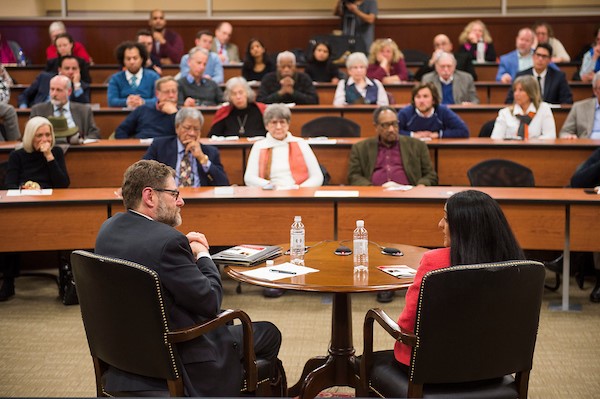
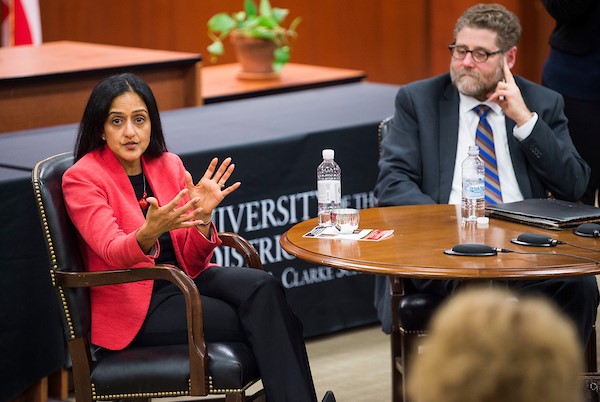
Jonathan Smith, left, and Rauh Lecturer Vanita Gupta, right, kick off the twenty-sixth annual Joseph L. Rauh, Jr. Lecture as the audience looks on.
The event reunited Gupta, who served as head of the Civil Rights Division of the U.S. Department of Justice during one of the most consequential periods for the division, with her former colleague Jonathan Smith, ’84, who served as Chief of the Special Litigation Section under Gupta’s leadership.
The interview-style conversation showcased Gupta’s profound knowledge and experience as a leading-edge civil rights litigator over the course of the wide-ranging discussion on the present landscape for civil and human rights in America. Throughout the evening, Gupta offered penetrating insight into rapidly-changing areas of law ranging from asylum law and constitutional structures to state-level bail reform and voting rights initiatives. Drawing on her experience as the chief civil rights prosecutor for the United States, Gupta weighed in on numerous, complex issues currently undergoing litigation and offered a hard-hitting critique of the Trump administration’s efforts to straitjacket the Department of Justice’s ability to investigate and prosecute civil rights violations and compromise the agency’s independence.
The Rauh Lecture: A Lasting Legacy
Chair Emeritus of the D.C. School of Law Foundation B. Michael Rauh opened the event with brief remarks on the history of the Foundation and the legacy of his late father Joseph L. Rauh, Jr., the liberal lion, civil liberties attorney, and founding member of the law school’s Board of Governors in whose honor the Rauh Lecture was established in 1993.
Rauh commended the selection of Gupta as this year’s Rauh Lecturer saying she “would lead the country in the good fight against” the current administration’s efforts to roll back civil and human rights protections, and he exhorted the many practicing lawyers and up-and-coming attorneys in the audience to stand ready to aggressively litigate for the protection of our democracy at her side.
B. Michael Rauh, D.C. School of Law Foundation Chair Emeritus. Lisa Helfert Photography.
“The Next Move”
UDC Law Acting Dean and Professor of Law John Brittain then took to the stage to introduce Gupta and Smith to the audience. Dean Brittain – who is himself a prominent civil rights litigator who has achieved many landmark victories for school desegregation during his decades-long career – celebrated Gupta’s remarkable perseverance and skillful leadership of the Civil Rights Division to secure groundbreaking victories for fair housing, voting rights, and police accountability in the federal courts despite “unremitting opposition” from a partisan Congress.
John Brittain, UDC Law Acting Dean and Professor of Law, introduces Rauh Lecturer Vanita Gupta and moderator Jonathan Smith to the audience. Lisa Helfert Photography.
Dean Brittain singled out as a high watermark of her tenure the division’s successful investigation and prosecution of police departments in Ferguson, Missouri, Baltimore, and Chicago. The groundbreaking investigations produced consent decrees with historic limits on racially-motivated policing and civil rights abuses that remain in force to this day. He went on to praise Gupta for choosing to join The Leadership Conference after leaving the Justice Department, saying that “Instead of ‘cashing out’ on her long record of public service after leaving the Justice Department, she doubled down” by joining the historic organization, which has coordinated the lobbying efforts on behalf of every major civil rights law since its founding in 1950.
Noting that Gupta and Smith, as Chief of the Special Litigation Section, shared leadership on the Justice Department’s civil investigation of the Ferguson, Missouri Police Department following the death of Michael Brown, Dean Brittain highlighted that the living room-style conversation offered listeners a rare opportunity to see this historic Justice Department “team in action.” “It’s like we’re together in a conference room in the Department of Justice,” said Dean Brittain, “and we’re planning the next move.”
“Gamechanger:” voting rights and ballot access
Jonathan Smith, who worked under Gupta’s leadership of the Civil Rights Division, opened the conversation-style portion of the lecture with high praise for Gupta’s “extraordinary career.” Smith recounted Gupta’s multiple and precedent-setting court victories, including her landmark litigation challenging wrongful convictions in Texas as an entry-level attorney with the NAACP Legal Defense and Educational Fund and extending through her criminal justice reform work and litigation at the ACLU challenging the detention of immigrant families in for-profit facilities.
For her part, Gupta praised the “extraordinary legacy of public service” that the Rauh family represents and its continued support of UDC Law, saying “the civil rights community is deeply indebted to all of you.”
Vanita Gupta, left, and Jonathan Smith, right. Lisa Helfert Photography.
With the stage set, the audience listened in rapt attention as Smith kicked off the discussion with a question about the 2018 midterm elections, asking Gupta what the Democratic takeover of the U.S. House of Representatives means for the civil rights agenda. Gupta responded that the election was, first and foremost, a “huge win for democracy” as a practical matter, because it restored a much-needed check in Congress after two years of one-party rule.
Gupta also emphasized the importance for civil and human rights in America of the election of several “first-ever” officials to Congress, including the first Muslim and first Native American women elected to Congress, and the historic number of women representatives in the House. She hailed the result as “a massive win for civil and human rights” with far-reaching implications.
Gupta also stressed the wave of progressive state-level ballot initiatives approved by voters. Gupta singled out the Florida initiative restoring voting rights to 1.4 million people convicted of a felony as a “gamechanger,” noting that it is “the single largest expansion of the franchise since the enactment of the Voting Rights Act in the ‘60s.”
In the wake of Charlottesville and constant attacks on immigrant families, Gupta described the November election results as a reaffirmation that “Americans will show up at the polls for the kind of country they want and the kind of country they deserve.”
“Despair is the luxury of the privileged”
The conversation shifted to the state of federal civil rights enforcement in the country, as Smith asked Gupta whether the new Congress can reverse the erosion of agency civil rights enforcement authority at not only the Justice Department’s Civil Rights Division but also at civil rights sections across the government, including the Department of Education and the Department of Health and Human Services.
Gupta responded with a laundry list of potential targets for congressional oversight in what she referred to as the administration’s “systematic effort” to dismantle civil rights enforcement authority encompassing “underenforcement at the Department of Education, the systematic withdrawal of guidances, the slowdown and lack of enforcement of laws that Congress enacted and gave to these federal agencies the mandate to enforce.” Expressing hope for improved oversight in the new Congress, Gupta stressed the important role the House can play in bringing the public’s attention to the “deeply important and historic role that the federal government has played in ensuring the protection of vulnerable and marginalized communities through its civil rights enforcement across agencies.”
Fair and independent courts are “fundamental” to democracy
Bringing the conversation around to the topic of the Senate’s role in confirming judicial nominees to the federal bench, and the Republican party’s continued control of the chamber, Smith asked Gupta what lessons she learned from The Leadership Conference’s effort to block the confirmation of now-U.S. Supreme Court Justice Brett Kavanaugh and other judicial nominees based on their records of opposition to civil rights and anti-discrimination measures.
Speaking to the history of The Leadership Conference, which she now leads, Gupta emphasized the importance of coalitional organizing to preserve the independence of the federal judiciary, which has for decades served as “a backstop against some of the most egregious excesses of the other two branches of government.”
In what she termed the “shocking” and aggressive reshaping of the federal courts in the past two years with the confirmation of “extremist nominees the likes of whom the Senate has never seen before,” Gupta signaled the dangerous and long-lasting consequences posed by these lifetime appointments, saying “my children, and probably their children, are now going to reap the seeds of what has been sown the last two years and unfortunately what is likely to continue the next two years.”
Gupta reflected that “the fight for fair courts has not been taken seriously enough” because “we often think about our issues in silos.” She emphasized how The Leadership Conference centers the importance of the foundational structures of democracy because “the fight to preserve the structures of our democracy – like the census, like the courts, like voting rights – are so crucial because everything else we care about, the courts directly have a say-so on.” The implications for civil rights litigators are dire, she added, with many civil rights litigators likely to avoid resorting to the Supreme Court to pursue alternative strategies for reform such as legislative advocacy and passage of state-level ballot initiatives.
“You can’t be a civil rights lawyer and have despair”
Predicting that the next two years will witness the Trump administration successfully filling all vacancies in the federal courts, Smith questioned “what, other than despair, can we do to change the dynamic and hold the Senate accountable.”
“You can’t be a civil rights lawyer and have despair,” Gupta said without missing a beat, adding that civil rights lawyers are almost by definition attorneys who battle against despair. “Hopelessness is an excuse for the privileged, so we don’t have the privilege of being hopeless. We must fight back.”
Gupta described the sweeping losses for civil and human rights witnessed in the past two years, saying “there is a still a deep and profound racism in this country, that has emboldened racism in the corridors of power,” but she rejected hopelessness and complacency outright. She identified the growing power of local and community-based groups organizing for progressive causes as reason for hope.
Sessions’ last act “another slap in the face of the Civil Rights Division”
Smith turned next to the “last act” of former U.S. Attorney General Jeff Sessions to issue a memorandum that straightjackets the Civil Rights Division’s historic work on police reform by restricting the division’s ability to pursue consent decrees through investigation and prosecution of patterns and practices of police misconduct.
Calling the move “another slap in the face of the Civil Rights Division,” Gupta noted that the memorandum targets the very work that was the major focus of her tenure at the Justice Department. She argued forcefully that the memorandum flies in the face of the statutory mandate given to the agency by Congress in 1994. The memorandum restricts approval of such consent agreements to political appointees, requires evidence of violations beyond unconstitutional behavior, and imposes an arbitrary “sunset” date on such agreements in place of court oversight and proof that the police department or law enforcement agency has improved the very practices governed by the agreement.
Gupta criticized the policy as “demoralizing” to the Justice Department’s career attorneys and “a real blow to civil rights enforcement around the country.” Nevertheless, Gupta found reason for hope, citing that the existing consent decrees previously filed with Article III judges remain in force and cannot be unilaterally revoked. She also lifted up the “extraordinary work” of state attorneys general, local mayors, and police department officials who have stepped into the gap to locally negotiate the measures.
“Despite the gutting of the Justice Department’s civil rights enforcement, the good news is there still is a lot of momentum on criminal justice reform, and we need to build on the powerful advocacy locally and at the state level to continue forward,” recommended Gupta.
Ballot access, the census
With a nod to her earlier remarks on the importance of shoring up fundamental structures that preserve American democracy like the federal courts, Gupta turned next to the ongoing battle over ballot access and the census.
Gupta surveys the six ongoing court battles over the Trump administration’s proposed “citizenship question” in the coming census that threatens to systematically undercount communities of color as a result of the chilling effect the change would have on mixed-status families. Gupta described the efforts of The Leadership Conference to unwind the move at the policy level and to increase funding of local efforts to organize for an accurate census count. She exhorted the audience to connect up with The Leadership Conference to get plugged in to local efforts.
Smith’s next question asked Gupta what can be expected form state legislatures around the country with regard to gerrymandering and voter suppression. Citing several state-level ballot initiatives during the midterm election that took the politics out of redistricting with the establishment of independent commissions, Gupta called for similar efforts in other states. She went on to describe the “phenomenal work” of groups such as the Lawyers’ Committee for Civil Rights Under Law, the NAACP Legal Defense and Educational Fund, and The Leadership Conference’s All Voting is Local campaign, which are fighting voter suppression at the local level around the country and pushing for same-day registration and early voting initiatives, but she warned that full ballot access will only be secured with the restoration of the Voting Rights Act and other reforms, like automatic voter registration, same-day registration, and early voting.
With the event drawing to a close, Dean Brittain returned to the podium to preside over a lively question and answer session with the audience covering critical issues such as the nationwide spike in hate crimes, local opportunities in the District to combat voter suppression and protect the census, and the potential for further action to limit or remove judges confirmed to the federal bench.
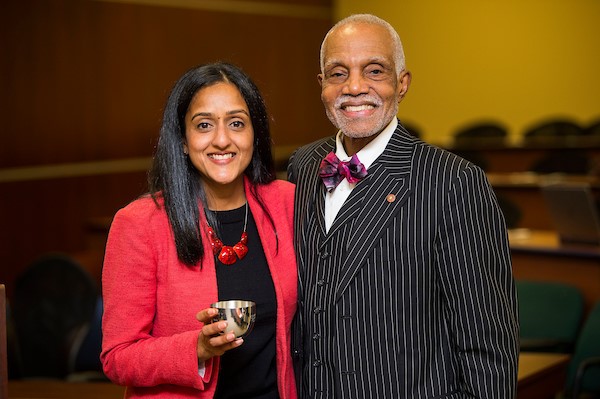
Dean Brittain concluded the powerful dialogue and led the audience in a round of applause before presenting Gupta with the UDC Law Dean’s Cup in appreciation for her contribution to the law school. He praised Gupta’s “powerful remarks” and seemingly “encyclopedic knowledge” she showed on the issues, calling her “an inspiration.”
UDC Law Acting Dean and Professor of Law John Brittain, right, awards Rauh Lecturer Vanita Gupta, left, the UDC Law Dean’s Cup. Lisa Helfert Photography.
Dean Brittain also lauded the “steadfast support of the law school and its critical mission” by Smith, who was UDC Law’s Associate Dean for Clinical Programs before transitioning to become the Executive Director of the Washington Lawyers’ Committee for Civil Rights and Urban Affairs. A catered reception followed, courtesy of the D.C. School of Law Foundation, offering guests an opportunity to speak with Gupta and other members of the UDC Law community.
About Vanita Gupta
Vanita Gupta is president and CEO of The Leadership Conference on Civil and Human Rights, the nation’s premier civil and human rights coalition. An experienced leader and litigator who has devoted her entire career to civil rights work, prior to joining The Leadership Conference, Gupta served from 2014 to 2017 as Principal Deputy Assistant Attorney General and head of the U.S. Department of Justice’s Civil Rights Division under President Barack Obama. As the chief civil rights prosecutor for the United States, Gupta oversaw a wide range of criminal and civil enforcement efforts to ensure equal justice and protect equal opportunity for all during one of the most consequential periods for the division.
Prior to joining the Justice Department, Gupta served as Deputy Legal Director and the Director of the Center for Justice at the ACLU. She began her career as an attorney at the NAACP Legal Defense & Educational Fund. Gupta earned her J.D. from the New York University School of Law, where she has also taught a civil rights litigation clinic.
About the Joseph L. Rauh, Jr. Lecture
The annual Joseph L. Rauh, Jr. Lecture series serves as a dedicated forum at the University of the District of Columbia David A. Clarke School of Law (UDC Law) in which leading members of the bench or bar speak directly to the people of the District and the law school community on issues of vital importance to the practice of law in the public interest.
Established in 1993 in honor of the late civil liberties attorney and founding member of the law school Board of Governors Joe Rauh, some of the nation’s most respected civil rights and public interest figures, including then-U.S. Attorney General Eric Holder, sitting U.S. Supreme Court Justices Ruth Bader Ginsberg and Sonia Sotomayor, and many others, have delivered the Rauh Lecture. The Rauh Lecture, which is open to the public and free of charge, includes a catered reception at the conclusion of the event courtesy of the D.C. School of Law Foundation.
About the UDC David A. Clarke School of Law
The University of the District of Columbia David A. Clarke School of Law (UDC Law) has the largest clinical requirement of any U.S. law school, providing more than 100,000 hours of legal services to thousands of D.C. residents each year through our nine legal clinics and robust experiential programs. UDC Law has garnered a No. 2 ranking by the National Law Journal (2018) for government and public interest job placement and No. 8 for Best Clinical Training Program by U.S. News & World Report (2019). For more information, please visit www.law.udc.edu.
Watch the lecture in its entirety on the UDC-TV YouTube channel here.





 Attorney General for the District of Columbia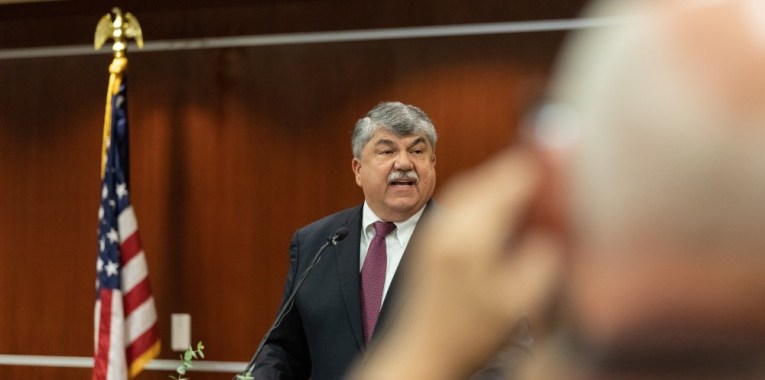




 DC School of Law Foundation